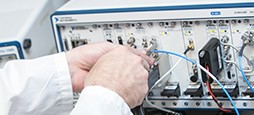
The NI PXI-5922 is a dual-channel flexible-resolution digitizer with the highest resolution and highest dynamic range of any digitizer on the market. It maximizes vertical resolution based on the selected sample rate, from 24 bits at rates up to 500 kS/s to 16 bits at 15 MS/s. This unparalleled flexibility and resolution are achieved with NI Flex II ADC technology, which uses an enhanced multibit delta-sigma converter and patented techniques for linearization. By combining the PXI-5922 with software such as NI LabVIEW, you can define functionality to create different instruments, such as DC and rms voltmeters, audio analyzers, frequency counters, spectrum analyzers, IF digitizers, and I/Q modulation analyzers, with measurement performance that exceeds that of high-end traditional instruments with similar functionality.
To use the NI PXI-5922 , you need all items in the diagram below. Select Option 1 if you already own a PXI System, or Option 2 if you do not already own a chassis, controller, or software.
Roll over the icons below to learn why you need each item in the system
Choose from hundreds of specialized instruments to create a PXI System that suits your measurement needs and can scale for future applications. Then, we'll help you choose the right hardware and software to complete your configuration.
Add More Measurements and I/O Modules Use the PXI Advisor to choose from a variety of modules including analog I/O, digital I/O, switching and more. Then, complete and price the PXI System.
Preview a Complete System View and price a complete PXI configuration including the NI PXI-5922, chassis, and controller. Starting from the default configuration, you can add modules, accessories, and software and customize your system.
You need a cable to transmit signals to your device.
The chassis provides rugged, modular housing for the controller and modules and contains the high-performance PXI backplane, which includes the system's data, timing, and triggering buses.
The controller runs your application and interfaces with your PXI modules.
You need software to interface with your hardware and to collect, analyze, present, and store your measurements. This board is compatible with a variety of programming languages, including LabVIEW, C/C++, Visual Basic, and .NET. LabVIEW provides the easiest integration with all of your NI hardware and is recommended to maximize your hardware investment.
You have selected United States as the country where you will use the product(s)
(change).
System Assurance Programs
Reduce your setup time and total cost of ownership, and get a system you can use out of the box with National Instruments system assurance programs. System assurance programs include:
Installation and integration test of all individual hardware
Courtesy installation of system driver sets and application development environments
Extended warranty and calibration coverage for up to five years
Custom documentation plus a custom restore and startup utility
This service is only available for PXI, NI CompactRIO, and NI Compact FieldPoint systems.
National Instruments designs and manufactures all products to minimize failures, however unexpected failures can still occur. Extended warranties provide a fixed economical price at the time of system purchase, covering any repair costs for up to three years. In addition, they offer the following benefits:
Significant cost savings compared to individual repair incidents
Fault location, diagnostics, and repair by NI any time the system product fails
All parts and labor costs covered as well as any adjustments needed to restore the hardware to manufacturing specifications
NI recognizes the need to maintain properly calibrated devices for high-accuracy measurements. NI provides manual calibration procedures, services to recalibrate your products, and automated calibration software to calibrate many NI measurement products.
Return your registered product under warranty at no additional labor and parts cost. NI offers fault location, diagnostics, and repair any time the system fails as well as any adjustments needed to restore the hardware to manufacturing specifications.